Email Us
admin@axiomvetlab.co.uk

admin@axiomvetlab.co.uk
(01626) 355655


We were sorry to hear of Biobest Laboratories closure in January, and we appreciate that this unexpected change may have caused disruption at an already busy time for farm practices. We would like to extend a warm welcome to all clients who have since joined us or enquired about our services. The Axiom team is here to ensure a smooth transition and to provide the reliable, high quality diagnostic support you and your farmers depend on. Please don’t hesitate to get in touch – we’re looking forward to working with you.
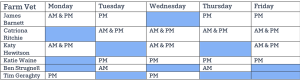
If you wish to speak to a particular farm vet about one of your cases, you can consult the table below to see when our vets are usually available. A duty farm veterinary advisor is always around on a Saturday morning from 9am-12pm.
We wish to remind vets that as a commercial laboratory we are unable to offer any Bluetongue testing either on blood samples or abortion material. If we receive samples from cases in which Bluetongue is suspected, we are required to safely dispose of the samples and cannot provide any further testing. We are always happy to discuss cases over the phone before submission of samples. Clinical suspicion of BTV infection must be reported to APHA. Further information on investigating poor reproductive performance in cattle and sheep during Bluetongue outbreaks can be found at the following link:

We are now carrying out the PCR test for Ovine Herpes virus -2 (the causative agent of Malignant Catarrhal Fever in cattle) in-house with an improved maximum turnaround time of five days. EDTA whole blood is the preferred sample type, but heparin whole blood and plain nasal swabs can also be tested. For postmortem cases a minimum of 1g of tissue (lymph node, spleen, lung , liver or thymus) can be tested.
We have validated a new method for differentiation of Haemonchus species from other Strongyle eggs in faecal samples. Haemonchus contortus speciation is now performed using the OvaCyte system and this method compares well with the PNA (peanut agglutination test) and offers a reduced turnaround time. Specificity has been estimated to be around 90%*. If a positive result is very unexpected (e.g. from a flock with no known history of Haemonchosis or a closantel post-drench check etc) it is important to be aware that the risk of a false positive cannot be entirely excluded. False positive risk may be higher in samples with a low total strongyle count. The PNA test continues to be available to further investigate an unexpected positive result if required.
*Elghryani N, Lahan G, Bor Gohain J, McOwan T and de Waal T (2025) Comparison of OvaCyte™ Speciation and PNA staining for the detection of Haemonchus contortus in ovine faecal samples. Front. Vet. Sci. 12:1688644. doi: 10.3389/fvets.2025.1688644
We have recently taken the decision to suspend our referral test for manganese on bloods for the foreseeable future, due to concern over reliability of recent results and inconsistencies in suggested reference intervals in the literature. Whole blood, plasma and serum manganese levels are known to be highly variable and generally considered to be a poor indicator of manganese status in the animal. Liver manganese levels are also variable but may be a more reliable indicator of status. Where manganese deficiency is suspected due to the birth of calves with appearance consistent with congenital joint laxity and dwarfism (CJLD) consider increasing manganese supplementation in the following season. This should be done as part of a range of measures which can include increasing level of non-ensiled feed to at least 30% Dry Matter intake, providing small amounts of supplementary concentrates and ensuring minimum National Research Council (NRC) mineral guidelines are met. If you are considering sending blood samples for manganese testing please feel free to contact us to discuss your case.
Our Johne’s & Neospora Monitoring programmes give farmers access to discounted test rates for whole herd or regular batch testing. There are no membership fees and no set rules to follow. Johne’s serology is from £5 per sample and Neospora serology costs from £6.75 per sample. It works out cheaper than testing through a CHECS cattle health scheme so is ideal for herds that are testing for disease control and management purposes. Advice is provided in the lab report and farmers can be e-mailed a copy if required. Our turnaround times are very fast– often same day but within three working days for both tests. Batch testing herds also get their results in a cumulative spreadsheet. A reminder to test email is sent out for herds on annual testing. Contact us for more information at dsfarm@axiomvetlab.co.uk or on 01626 357776.
Cattle
Abortions/mastitis
Respiratory disease
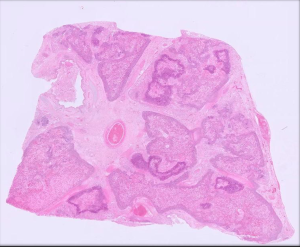
Figure 1: Section of lung from a heifer showing extensive inflammation and necrosis typical of Mannheimia haemolytica fulminating pneumonia.
Gastrointestinal disease
Skin and eye disease
Systemic and miscellaneous disease
Reproductive disease, mastitis
Respiratory disease
Gastrointestinal disease
Skin and eye disease
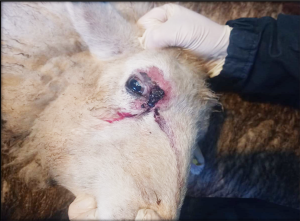
Periorbital eczema in a ewe (Photo by Laura Barlow, Castle Farm Vets, Barnard Castle)
Systemic and miscellaneous disease
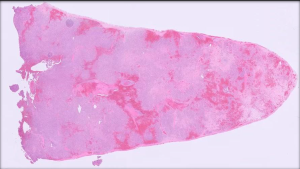
Figure 2: Low power view of the spleen showing near diffuse effacement of normal architecture by a proliferation of neoplastic epithelial cells.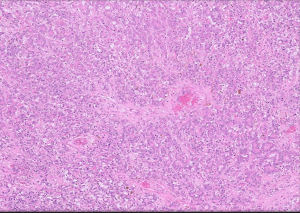
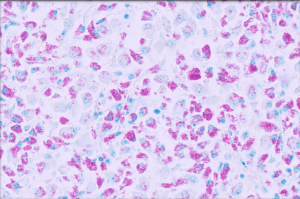
Figure 4: Abundant acid-fast bacteria stained pink with Ziehl-Neelsen special stain, in the intestine of an alpaca with Johne’s disease
Farm September Newsletter 2026 Dedicated farm line – 01626 357776 Follow us on Facebook https://www.facebook.com/Axiomfarmvetlab/…
Farm August Newsletter 2026 Dedicated farm line – 01626 357776 Follow us on Facebook https://www.facebook.com/Axiomfarmvetlab/…
Farm July Newsletter 2026 Dedicated farm line – 01626 357776 Follow us on Facebook https://www.facebook.com/Axiomfarmvetlab/…
Farm June Newsletter 2026 Dedicated farm line – 01626 357776 Follow us on Facebook https://www.facebook.com/Axiomfarmvetlab/…

The great explorer of the truth, the master-builder of human happiness no one rejects dislikes avoids pleasure itself because it is pleasure but because know who do not those how to pursue pleasures rationally encounter consequences that are extremely painful desires to obtain.
Read More