Email Us
admin@axiomvetlab.co.uk

admin@axiomvetlab.co.uk
(01626) 355655

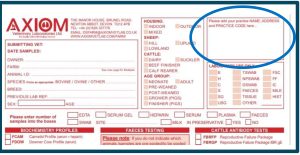
We love getting your samples to test, but please let us know on the form which veterinary practice they have come from! Each month we receive hundreds of submissions form with no practice details. Luckily the postal room and diagnostic support teams are great at detective work and many of the mystery samples can be traced. However, trying to track down the origin of samples can significantly delay their arrival in the testing departments, potentially increasing turnaround times. The most up to date versions of the forms can be found on our website to download but note these do not automatically include practice codes or details so these need to be added before sending.
If you wish to speak to a particular farm vet about one of your cases, you can consult the table below to see when our vets are usually available. A duty farm veterinary advisor is always around on a Saturday morning from 9am-12pm.

We are now carrying out the PCR test for Ovine Herpes virus -2 (the causative agent of Malignant Catarrhal Fever in cattle) in-house with an improved maximum turnaround time of five days. EDTA whole blood is the preferred sample type but heparin whole blood and plain nasal swabs can also be tested. For postmortem cases a minimum of 1g of tissue (lymph node ,spleen, lung , liver or thymus) can be tested.
We have validated a new method for differentiation of Haemonchus species from other Strongyle eggs in faecal samples. The new technique uses digital technology (Ovacyte) to identify Haemonchus sp. The turnaround time for the test has been improved whilst maintaining comparable sensitivity and limit of detection to the peanut agglutination test. We are hopeful that this will assist vets in rapidly detecting and dealing with increasing numbers of haemonchosis cases on farms throughout the UK.
Our Johne’s & Neospora Monitoring programmes give farmers access to discounted test rates for whole herd or regular batch testing. There are no membership fees and no set rules to follow. Johne’s serology is from £5 per sample and Neospora serology costs from £6.75 per sample. It works out cheaper than testing through a CHECS cattle health scheme so is ideal for herds that are testing for disease control and management purposes. Advice is provided in the lab report and farmers can be e-mailed a copy if required. Our turnaround times are very fast– often same day but within three working days for both tests. Batch testing herds also get their results in a cumulative spreadsheet. A reminder to test email is sent out for herds on annual testing. Contact us for more information at dsfarm@axiomvetlab.co.uk or on 01626 357776.
What is an appropriate Johne’s ATV for dairy herds using blood testing?
The concept of a setting a target Average Test Value (ATV) is not only to encourage progress with Johne’s control but also to discourage retention of known infected animals in the herd. The Johne’s Control Initiative set an ATV target of 5.5 for herds using milk serology but it was unknown what an appropriate target should be for dairy herds using the more sensitive blood serology for screening.
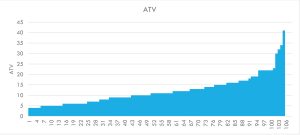
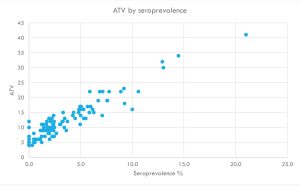
We have therefore reviewed our blood serology data for 62 dairy herds with up to four complete years of herd screening results. ATVs were calculated for 105 complete sets of adult herd tests (not including 30-60 cow subset screens). The ATVs ranged from 4 to 41:
The ATVs were plotted against the herd seroprevalences and there is a good correlation:
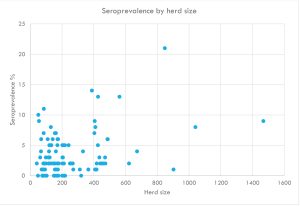
There was a tendency for larger herds to have a higher seroprevalence:
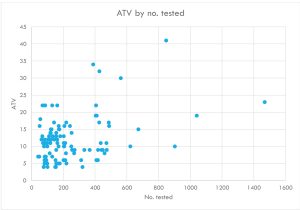
This is also reflected in the ATVs as follows:
The ATVs were put into bands and the approximate seroprevalences are shown in the table below:
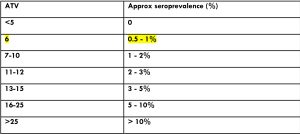
A target of below say 12 could be chosen initially, which equates to a seroprevalence of approximately 2-3%. As the herd progresses the target could be adjusted to say 6, which would be an approximate blood seroprevalence of below 1%. This ATV target of 6 on blood serology is similar to the milk target of 5.5 set by the JCI (we are unaware what milk seroprevalence their ATV relates to. Milk serology is also less sensitive than blood serology). For high seroprevalence herds their initial target could be set at perhaps 20 initially.
A herd with an ATV of 4 and no positives detected is likely to be a lower risk herd than a herd with an ATV of 10 where there had also been no positives identified as there could be a higher risk of subclinically infected animals being present in the latter.
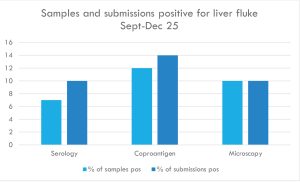
In the current autumn-winter period only relatively small numbers of submissions have tested positive for liver fluke.
Using the coproantigen ELISA on faeces 1 in 7 submissions (75 from 536) have tested as positive (14% of submissions, 12% of the individual samples (106 from 869).
About 60% of the positive submissions were from sheep and just over a third were from cattle with camelids making up the remainder.
(With the remaining 8% it was unclear if they were from individuals or pre-pooled)
With the serology test one in ten submissions had positive results, indicative of exposure, and it was same level of positive submissions with fluke microscopy for eggs.
957 individual blood samples tested of which 63 were positive = 6.6% of samples
235 pooled samples were tested for antibodies of which 15 were positive = 6.4% of samples
The higher proportion of positive samples in the fluke antigen ELISA appears to be down to samples from the west of Scotland, which were mainly tested with this method and the vast majority of them were positive.
It is likely that drought conditions in some areas in recent years have eliminated or reduced the number mud snails, which are an essential part of the liver fluke life cycle. Encourage farmers to test to determine if treatment is required rather than automatically treating for liver fluke, which could save them money and time. It is of course important to sample sufficient animals.
When sending submissions containing 50+ bloods, please ensure that you use a Field Kit containing a polystyrene sample rack/box for the orderly transportation of your samples, remembering to populate the rack in the same order as your accompanying animal ID list. Receiving large quantities of blood samples in a plastic bag or cardboard box is not appropriate or conducive to the efficient handling of such submissions and invariably leads to significant delays in preparation and turnaround times.
Field Kits (filled with the required serum gel tubes) are readily available to order via the following link… https://milab.store.unleashedsoftware.com/
Cattle
Abortions
Respiratory disease

Figure 1: Cow pulmonary thromboembolism. Caption ‘A large vessel occluded by fibrin, inflammatory cells and bacteria in a cow with a septic pulmonary thromboembolism’.
Gastrointestinal disease
Skin and eye disease
Systemic and miscellaneous disease
Gastrointestinal disease
Systemic and miscellaneous disease

Figure 2a: ‘Teratoma in an alpaca testicle. Islands of cartilage (*), cysts lined by epithelium (arrows) and frequent hair follicles (circles) are seen throughout’.

Figure 2b: ‘Right testicle appears more normal’.
Farm September Newsletter 2026 Dedicated farm line – 01626 357776 Follow us on Facebook https://www.facebook.com/Axiomfarmvetlab/…
Farm August Newsletter 2026 Dedicated farm line – 01626 357776 Follow us on Facebook https://www.facebook.com/Axiomfarmvetlab/…
Farm July Newsletter 2026 Dedicated farm line – 01626 357776 Follow us on Facebook https://www.facebook.com/Axiomfarmvetlab/…
Farm June Newsletter 2026 Dedicated farm line – 01626 357776 Follow us on Facebook https://www.facebook.com/Axiomfarmvetlab/…

The great explorer of the truth, the master-builder of human happiness no one rejects dislikes avoids pleasure itself because it is pleasure but because know who do not those how to pursue pleasures rationally encounter consequences that are extremely painful desires to obtain.
Read More